-
- En
-
-

For high-speed, compact detection systems, especially PET and high-count-rate applications, LYSO is usually the more suitable scintillation crystal because it offers high density, strong gamma-ray stopping power, fast decay time, and non-hygroscopic properties. For conventional gamma spectroscopy, radiation monitoring, and applications that place greater emphasis on high light output, large crystal sizes, and cost-effectiveness, NaI(Tl) remains a very mature and practical choice.
There is no absolute superiority between the two materials. The appropriate scintillator material should be selected according to the detector’s specific requirements for timing performance, detection efficiency, energy resolution, size, environmental stability, and system cost.
LYSO, or lutetium yttrium oxyorthosilicate, is a cerium-activated, high-density inorganic scintillator widely used in PET scanners and high-energy radiation detectors.
NaI(Tl), or thallium-doped sodium iodide, is one of the oldest and most mature gamma-ray scintillation materials currently in use.
The main differences between the two materials are as follows:
| Performance Parameter | LYSO(Ce) | NaI(Tl) |
|---|---|---|
| Density | Approx. 7.1–7.2 g/cm³ | Approx. 3.67 g/cm³ |
| Light Yield | Approx. 30,000–33,000 photons/MeV | Approx. 38,000–55,000 photons/MeV |
| Decay Time | Approx. 40–45 ns | Approx. 230–250 ns |
| Emission Peak | Approx. 420 nm | Approx. 415 nm |
| Hygroscopic | No | Yes |
| Typical Energy Resolution at 662 keV | Approx. 8%, depending on the system | Approx. 6–7% |
| Main Advantages | Fast response, high stopping power | High light output, cost-effective |
| Typical Applications | PET, TOF-PET, high-speed radiation detection | Gamma spectroscopy, SPECT, radiation monitoring |
LYSO has a density of about 7.2 g/cm³ and a decay time of about 40 ns; in comparison, NaI(Tl) has a density of about 3.67 g/cm³ and a decay time typically around 250 ns.
There is another very important difference in practical applications: NaI(Tl) is clearly hygroscopic and therefore usually requires hermetic packaging, while LYSO scintillator does not require the same level of moisture protection.
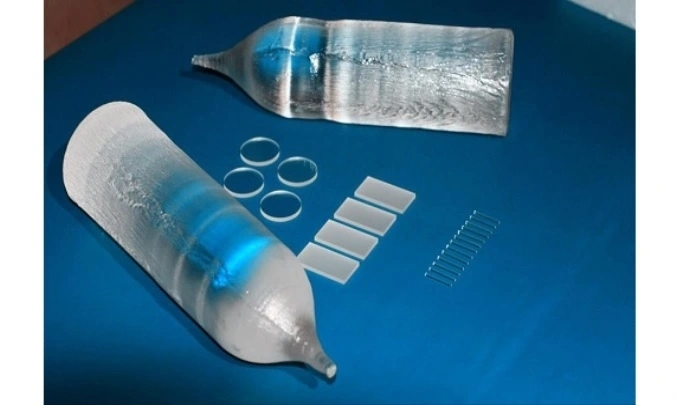
Sodium iodide scintillator usually has a higher light yield.
The typical light yield of NaI(Tl) is about 38,000–55,000 photons/MeV, while LYSO is usually about 30,000–33,000 photons/MeV. Higher light output helps improve signal statistics, which is one of the important reasons why NaI(Tl) has long been widely used in gamma spectroscopy measurements.
However, detector performance cannot be judged based on light yield alone. Actual performance is also affected by optical coupling, crystal size, reflector material, photosensor efficiency, electronics, and signal processing methods.
Yes, and this is one of the most obvious advantages of LYSO.
The typical scintillation decay time of LYSO is about 40 ns, while NaI(Tl) is usually about 230–250 ns.
A faster response means that LYSO detectors can more effectively distinguish radiation events that occur at short time intervals, making them especially suitable for high-count-rate systems and coincidence timing applications.
Higher density usually means stronger gamma-ray stopping power, allowing a higher interaction probability within a smaller crystal volume.
LYSO has a density of about 7.1–7.2 g/cm³, nearly twice that of NaI(Tl). Combined with its relatively high effective atomic number, LYSO provides strong stopping power for high-energy photons, including the 511 keV annihilation gamma photons commonly found in PET systems.
This is also why compact LYSO detector arrays are widely used in modern medical imaging systems.
Modern PET systems require efficient detection of 511 keV gamma photons, as well as fast timing response and compact detector structures.
LYSO scintillator offers the following advantages:
High gamma-ray stopping power
Fast scintillation decay
Good light output
Good radiation resistance
Non-hygroscopic
Suitable for integration with compact SiPM arrays
These properties make LSO and LYSO very widely used scintillation materials in modern PET detectors.
For TOF-PET (time-of-flight PET), the fast response of LYSO is particularly important because the timing performance of the detector directly affects coincidence time resolution.
However, LYSO also has one characteristic that needs to be considered: natural lutetium contains the radioactive isotope ¹⁷⁶Lu, which produces a certain intrinsic radiation background. In PET systems, this background is usually acceptable, but it should be carefully considered in ultra-low-activity measurements or low-background detection systems.
NaI(Tl) combines high light yield, mature crystal growth technology, good large-size production capability, and relatively high cost-effectiveness.
A properly designed NaI Tl crystal detector can provide good gamma energy resolution performance. Common applications include:
Gamma spectroscopy
Radiation survey meters
Environmental radiation monitoring
Nuclear medicine gamma cameras
Laboratory radiation detectors
Industrial measurement systems
NaI(Tl) remains a very common detector material in traditional gamma camera systems. However, because it is strongly hygroscopic, a reliable hermetic packaging structure must be used.
When choosing between LYSO and NaI(Tl), a more reasonable approach is to start from the overall performance requirements of the detector rather than comparing only a single material parameter.
LYSO is more suitable in the following situations:
High timing response requirements
High system count rate
Need to achieve high gamma detection efficiency in a small volume
Need for integration with SiPM arrays
Preference for better moisture resistance of the crystal
Use in PET or TOF-PET systems
NaI(Tl) is more suitable in the following situations:
Mainly used for gamma spectroscopy measurements
High scintillation light output requirements
Need for larger crystal sizes
Detector cost is relatively sensitive
Timing response requirements are not especially high
Hermetic packaging is acceptable
For purchasers, crystal geometry is no less important than the material itself. Crystal thickness, pixel size, surface treatment, reflector design, optical coupling method, and photodetector type should all be matched according to the radiation energy and detector structure. When evaluating different inorganic scintillator options, material properties, detector structure, and specific application requirements should be considered comprehensively in order to achieve the expected performance.
For example, if a gamma spectroscopy system is most concerned with energy resolution, effective detection area, and cost, replacing NaI(Tl) with LYSO simply because LYSO has higher density may not necessarily improve overall performance.
Conversely, if a high-speed coincidence detector requires excellent timing performance and high stopping power, choosing NaI(Tl) simply because it has higher light yield may also fail to meet system requirements.
It depends on the specific detector. NaI(Tl) is very suitable for conventional gamma spectroscopy and radiation monitoring, while LYSO is more suitable for compact gamma detection systems that require high detection efficiency and fast timing response.
Not necessarily. In well-designed detectors, NaI(Tl) can typically achieve an energy resolution of about 6–7% at 662 keV, while a typical LYSO detector may be around 8%. Actual results also depend on crystal quality and detector design.
Yes. NaI(Tl) is strongly hygroscopic. If exposed to humid air for a long time, its optical and scintillation performance may degrade, so hermetic packaging is usually required.
Yes. The lutetium in LYSO contains naturally occurring ¹⁷⁶Lu, which produces a certain intrinsic radiation background. This usually has limited impact on PET applications, but it needs to be considered in low-background measurements.
Usually yes. LYSO offers high density, fast decay, good gamma-ray stopping power, and non-hygroscopic properties, making it more suitable for modern PET and TOF-PET detector designs.
For custom detector projects, it is recommended to provide information such as the scintillation material type, crystal dimensions, tolerances, surface treatment, reflector requirements, optical coupling method, photosensor type, target radiation energy, and operating environment.
OST Photonics can provide customized LYSO scintillator and sodium iodide scintillator solutions for medical imaging, gamma-ray detection, radiation monitoring, and scientific research detection systems. Providing detailed application requirements at the quotation stage helps further determine the appropriate crystal size, surface treatment, packaging form, and optical interface.